
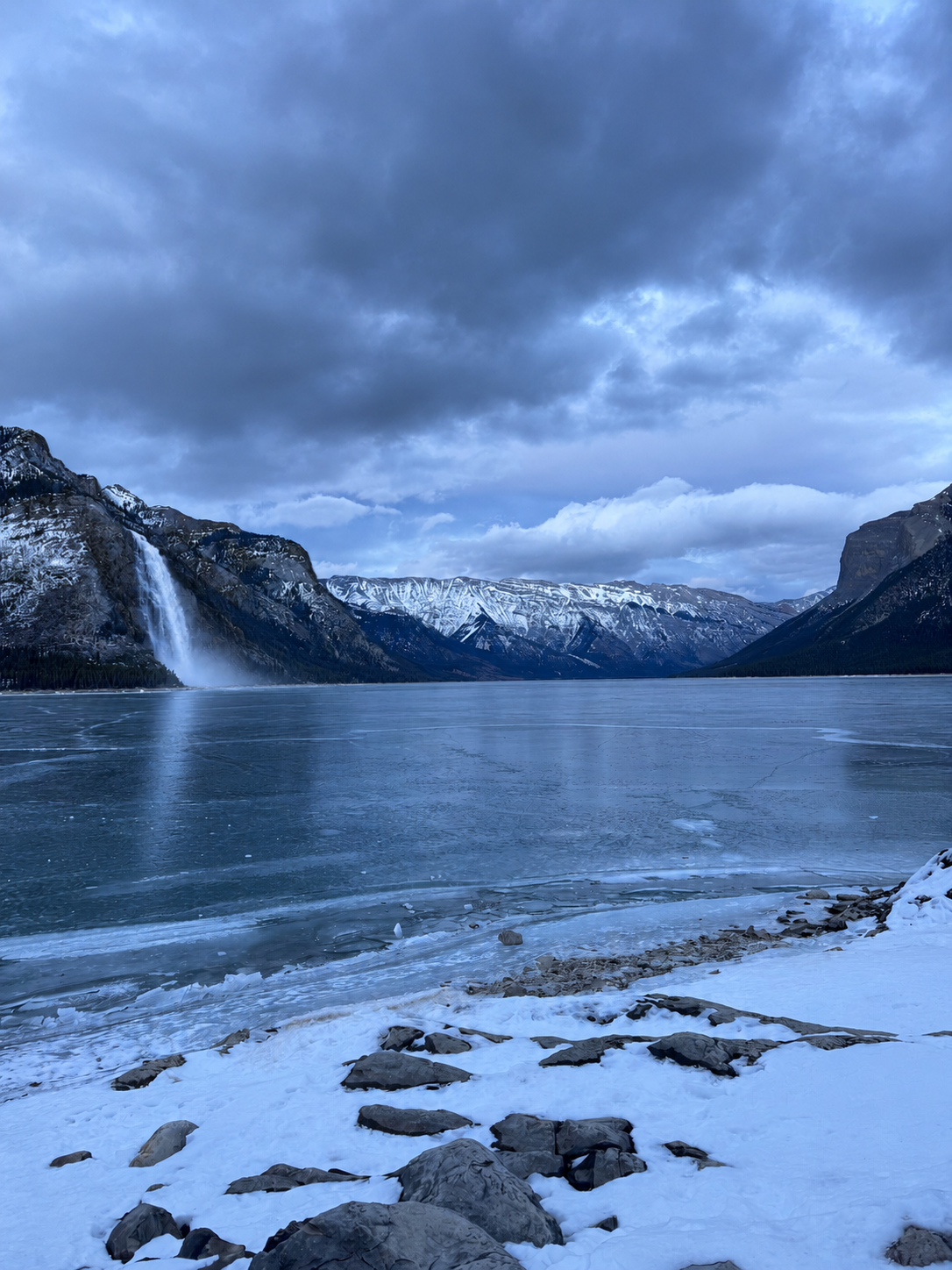
Two Oceans Meeting Can Lead to Two Landscapes Touching Each Other
October reflections — Michèle Keatley
Some creative work arrives quietly.
It does not necessarily begin with the intention of becoming a song, or even knowing what it wants to say. Sometimes it grows through conversations, experiences and moments that have been sitting somewhere in the background for years.
I have been reflecting on how these experiences find their way into my writing, and how a lyric can develop beyond the page into music, landscape, movement and other forms of creative expression.
I would describe my writing as an imagistic, associative practice. I use landscape, physical sensation and recurring natural elements to approach memory, emotional depth and the unseen. Sometimes an image carries an emotion that cannot be explained directly. Sometimes the natural world becomes a way of approaching something that is difficult to name.
There is a distinction, for me, between writing about spirituality and allowing a spiritual dimension to arise through the writing itself. I am interested in writing towards what cannot be fully explained, leaving room for the listener or reader to enter the work and discover their own dimension within it.
Waterfall — a vessel of connection
“Waterfall” is one example of how this process can unfold.
The song grew from a combination of friendship, conversations, shared experiences and spiritual questioning. A dear friend, who has been part of our family journey for more than ten years, has travelled extensively and explored his own spiritual quest, including time in Bali, Indonesia. He is also an incredibly talented pianist and artist.
Over the years, we have talked about Spirit, consciousness, the divine and what it means to be human, sometimes alongside another kindred spirit whose own spiritual insight has brought a different perspective to our conversations.
Some of these moments have unfolded outdoors, gathered around an open fire beneath the night sky, surrounded by the natural elements, with laughter, reflection and the freedom to let a conversation wander wherever it might lead.
They have rarely been conversations in which we arrived at definitive answers. More often, they opened another question.
One observation he shared with me has stayed in my thoughts:
“In Bali they make you look at yourself.”
The shadow as well as the light.
He also described an experience of sailing on a completely calm ocean, sitting on the edge of a wave beneath the constellations. Beyond him was what he described as oblivion — not in a fearful sense, but as a place of quietude, immense space and connection with the rhythms of life.
I have never forgotten that image.
These conversations, alongside his encouragement not to give up on my art, became part of the wider experience from which “Waterfall” eventually emerged.
The song began as words, the whispers of a poem, gradually finding their way towards a lyric. As I started listening to those words against musical references, the writing began to change. A phrase that seemed complete on the page suddenly felt as though it wanted to go somewhere else. A melody revealed another possibility. A word carried a different weight when it was sung.
I began to expand the poem through listening, rather than deciding beforehand what the finished lyric should be.
The song slowly revealed itself.
Perhaps that is why the idea of a vessel found its way into the writing.
Because “Waterfall” became a vessel of connection. Not physical intimacy in the conventional sense, but something harder to describe: a connection between people, between experience and memory, between the visible and the unseen, between one life and the possibility of something beyond it.
There is a line in the song:
“the vessel of the divine”
I did not set out to write this as an explanation. It simply became the language that felt right.
For me, the spiritual dimension of “Waterfall” is not a conclusion that I am asking the listener to accept. It is part of the landscape of the lyric, something that can be approached and experienced in different ways.
Sometimes someone does not have to create the work with you to become part of its story. Conversations, perspectives, encouragement and shared experiences can travel quietly into creative work.
That is one kind of creative connection: something lived, remembered and gradually transformed through writing.
The many worlds within a lyric.
I explored this connection further in my earlier reflection, [Waterfall — A Journey of Connection, flowing into September], where I considered the conversations, experiences and encouragement that gradually found their way into the song.
A different aspect of my creative practice is beginning to emerge through a new body of lyric work, opening with ‘Forever Avenue’.
This is a stark, multi-character narrative, moving between different lives and circumstances: the bridge, the mother and sisters, the highway, the corridors and the garden. Its recurring line, “So I’m holding you as I cry”, becomes an emotional thread through the different perspectives, before the climactic release into “our forever avenue”.
The writing draws on raw observations of real experiences, but I am interested in exploring the many worlds the lyric can inhabit.
When I read the piece, I begin to see plateaus within the language. There are points where the emotional intensity rises, where the landscape opens out, where a character enters, where movement becomes possible and where silence needs to interrupt the action.
These changes begin to suggest a form of lyric-led visual dramaturgy: imagining a work as a space that can be entered, inhabited and transformed into different visual and emotional worlds.
A bridge might become a mountain ascent. A highway might suggest the lines of a life. The mother’s journey might become a passage through a vast landscape. Caverns, mountains and running water can become more than settings; the geography itself can carry the visual language of the work.
I am drawn to the possibility of contrasting performance worlds emerging from the same underlying lyric. One interpretation might remain close to the circumstances and observations in the writing; another might move into a more elemental, symbolic landscape.
Neither has to cancel the other. Each can reveal something different.
The question becomes what each world allows us to see, and what it might reveal that another interpretation cannot.
This is part of what interests me about working across creative forms. The writing does not necessarily end at the lyric. It can become a starting point for another way of seeing, hearing and experiencing the work.
Two oceans meeting
Thinking about creative connection brings me to a wider observation:
*Two oceans meeting can lead to two landscapes touching each other.*
[ quote – Michèle Keatley © 2026 ]
Artists can recognise something familiar in another person’s work: an atmosphere, a spiritual or elemental territory, a sensitivity to landscape, or an emotional quality that resonates. Such recognition can be valuable. It can open new ways of thinking and encourages us to explore our own creative possibilities.
But I think it is important to distinguish between the influence of lived experience and the recognition of artistic resonance.
With ‘Waterfall’, I can identify conversations, friendship and encouragement that became part of the song’s story. With another artist’s work, I may recognise a shared territory or find something that resonates with my own creative thinking. These experiences are not interchangeable, but both can contribute to the way we understand our own practice.
I do not believe creativity is neatly divided between amateur and professional identities. Those terms can describe circumstances, experience, training or the context in which someone works, but they cannot define the entirety of an evolving creative identity. We are all learning, discovering and finding new ways to express what matters to us.
At the same time, artistic recognition and personal or professional reciprocity are not the same thing. A sense of creative resonance can be meaningful without assuming that an unspoken understanding or collaboration has already been established.
It is possible to appreciate another artist’s work without attempting to reproduce their language. I would never want to write as another artist. The more interesting possibility is that two distinct creative landscapes can touch, each retaining its own character.
Writers can inspire one another without becoming versions of one another.
The meeting does not require either landscape to disappear into the other.
A creative practice still unfolding
Looking across pieces such as *Infinity*, *Waterfall*, *Iona* and *Salt Across The Water*, I can see recurring interests in natural imagery, memory, spirituality, physical sensation and the spaces between what we know and what we feel.
Each piece has its own identity, but these elements continue to find their way into the writing. They are not necessarily subjects I set out to address. More often, they emerge through the images, structures and language as a piece develops.
Alongside this work, *This House* is now in its final stages, while I am completing the musician’s sheet for *The Curve*. I am also making considered revisions to the website, bringing its presentation into clearer alignment with the creative work and the wider practice.
Much of this development takes place in the spaces between other commitments. Some pieces take time to find their final shape, and some ideas need room to evolve before they are ready to be shared. I prefer to give the work that attention while continuing to move forward.
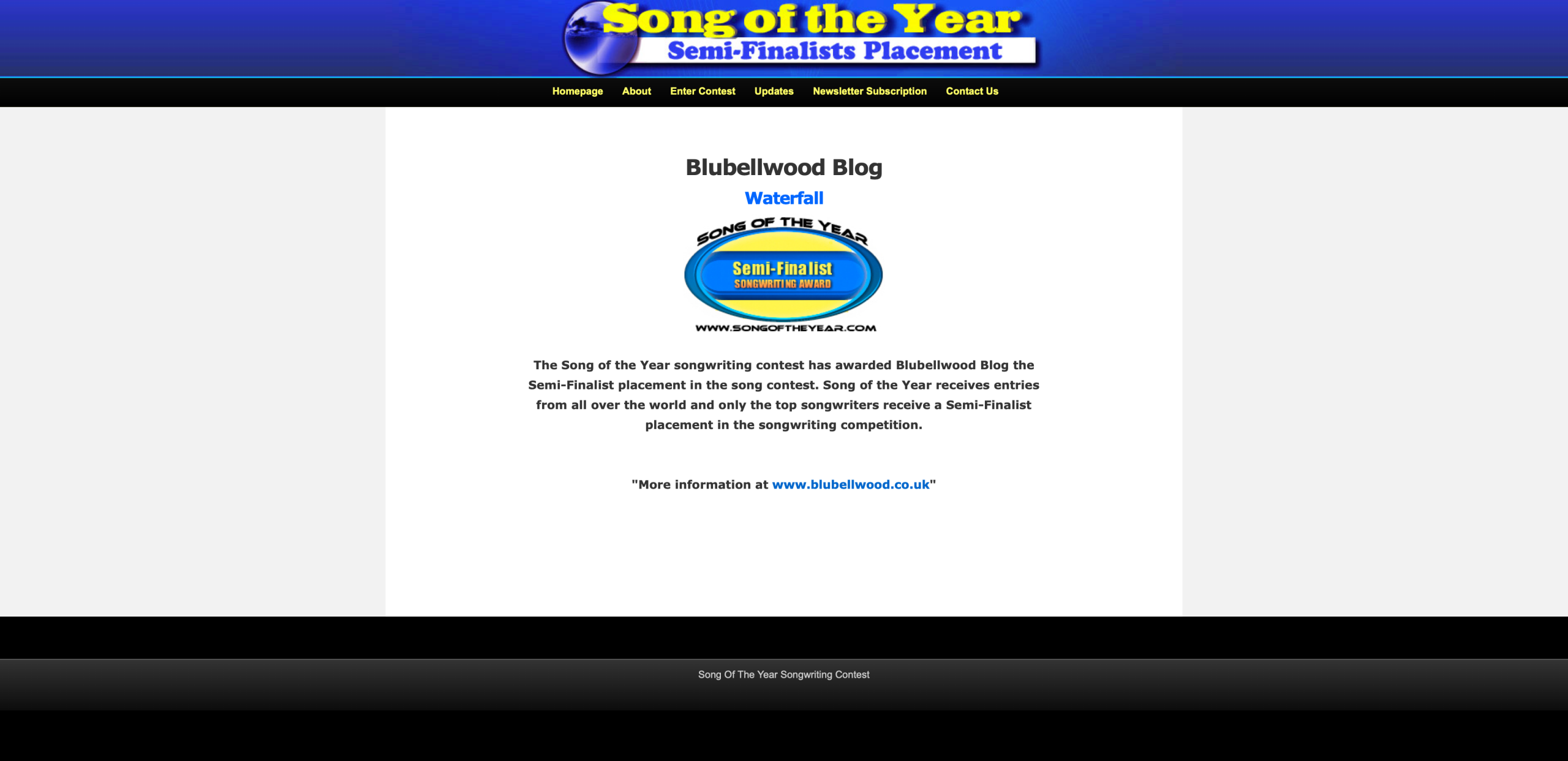
There has also been a welcome milestone for ‘Waterfall‘, which has received a **Semi-Finalist Songwriting Award from Song of the Year**. It is encouraging to see the piece recognised, by some incredible leading music artists, particularly as it carries so much of the imagery and thinking that have become part of my wider creative language.
WATERFALL
The technology and musical tools I use can become part of the process, but they do not replace its starting point. The source remains the writing: its images, structures, observations and turns of phrase. From there, music, visual storytelling and other creative forms can develop.
For now, I am bringing existing work towards completion while allowing the next body of lyrics to take shape. I am interested in where the writing might lead, and in the different worlds that may emerge from it.
Two oceans meeting can lead to two landscapes touching each other. The landscapes remain distinct, but their meeting can create space for something new.
© 2026 Michèle Keatley
Blubellwood Blog — Music · Lyrics · Art & Spirit
#BlubellwoodBlog #MicheleKeatley #LyricWriting #Songwriting #CreativeProcess #VisualStorytelling #NatureAndSpirit #ArtisticIdentity #TwoOceansMeeting #SongOfTheYear
#SongwritingAward


You must be logged in to post a comment.